
To investigate presenting signs and symptoms, preoperative workup, operative therapy, and morbidity of parotid gland's benign and malignant lipomatous lesions.
STUDY DESIGN: Medical literature review and retrospective chart review for all patients who underwent surgery for lipomatous lesions of the parotid gland at our institution from 1959 to 2009.
METHODS: Seventy patients underwent surgery for such lesions. Histologic sections were stained with hematoxylin-eosin and reviewed, and clinical information was obtained from hospital medical records for each case.
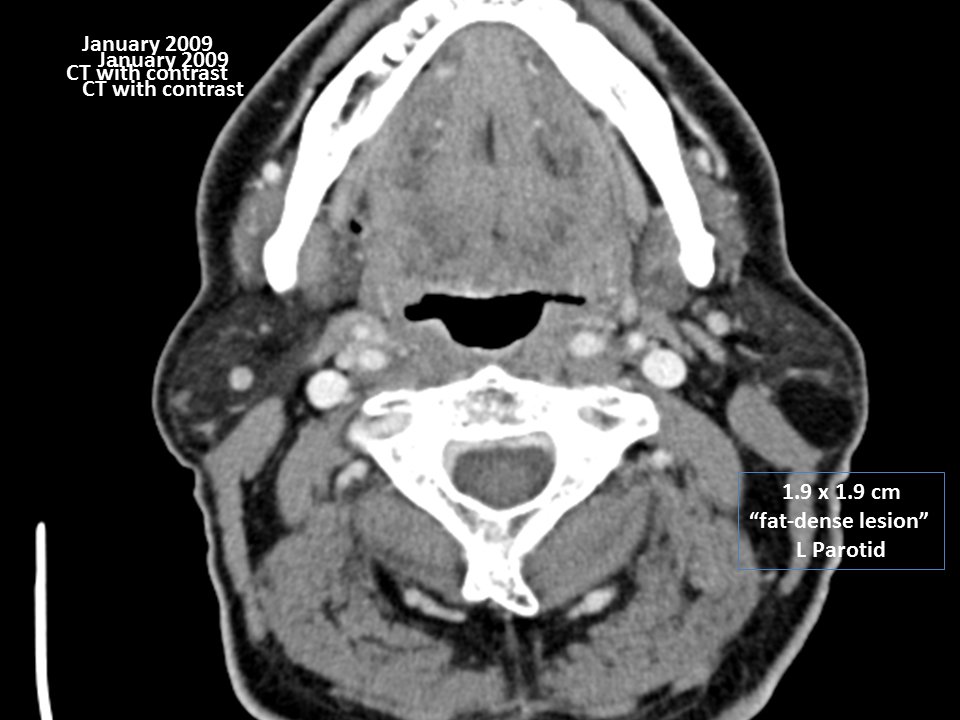
RESULTS: Forty-nine patients (70.0%) were male and 21 (30.0%) female (mean age, 49.9 years). Of the lesions, 43 (63.2%) were intraparotid, 25 (36.8%) periparotid, 69 (98.6%) unilateral, and 1 (1.4%) bilateral (average size, 3.7 cm). Fifty-nine patients were treated with superficial or partial superficial parotidectomy, 10 were treated with total parotidectomy, and one was treated with parapharyngeal space dissection. Complications included six cases (8.6%) of facial paresis or paralysis and two cases of hematoma. No lesions recurred.
CONCLUSIONS: We present the largest series, to our knowledge, of lipomatous lesions of the parotid gland. These masses, although rare, should be considered in the evaluation of a parotid mass. This series provides insight into the clinical presentation, diagnostic evaluation, and surgical treatment of parotid lipomatous lesions. Surgical extent depends on lesion location in the gland. Lipomatous masses can be effectively treated surgically with low morbidity and high cure rates.
Copyright © 2012 The American Laryngological, Rhinological, and Otological Society, Inc.